Product

One platform, from finding the tender to winning it.

Klarum turns the chaotic global firehose of public tenders into a ranked, explained shortlist, then carries the winners all the way to a submitted bid, grounded in your firm's own evidence and run by an AI copilot that knows your book of work.

How it fits together

Six layers, one shared record.

Discover

Find the right tenders

Win

Run the bid to submission

Intake

Capture inbound deal-flow

Know

Your evidence, structured

Operate

Track, measure, automate

Copilot

An AI that knows your firm

Every module reads and writes the same canonical record: the tender, the buyer, the bid, the evidence. Discovery flows straight into a workspace, a workspace into a submitted proposal, and the whole funnel into analytics. Nothing is a siloed tool bolted on the side.

Discover

Find the tenders worth bidding on.

Every open public tender and aid-funded opportunity, normalised into one feed, ranked for your firm, and explained so you can defend the go/no-go.

Tender Discovery & Matching

One global feed, ranked for your firm

A single searchable index of every open tender Klarum ingests across TED, SAM.gov, the World Bank, EBRD, UK Find-a-Tender, ProZorro, Brazil's PNCP, AusTender and more, collapsed into one normalised feed.
Tender match scoring in Klarum
  • Stop trawling dozens of procurement portals; search one place
  • Search the way you think with a plain sentence, not CPV codes
  • Open the app to a curated, pre-scored shortlist every morning
  • Turn any tender into a working bid in one click

Why it's better

A multi-signal matching engine turns a firm and a tender into a calibrated fit score plus a human-readable reason: sector overlap, geographic coverage, budget fit, track-record evidence and requirement coverage. A ranking becomes a defensible recommendation, not a black box.

AI inside

Semantic embedding search captures fit that keyword rules miss; a cross-encoder reranks the shortlist for precision; requirement-level extraction checks how many of a tender's mandatory criteria your firm actually meets. Heavy AI runs nightly and is cached, so browsing stays instant.

The front door of the platform. A matched tender becomes a Workspace in one click.
Notices & Featured

The raw universe and your personalised feed

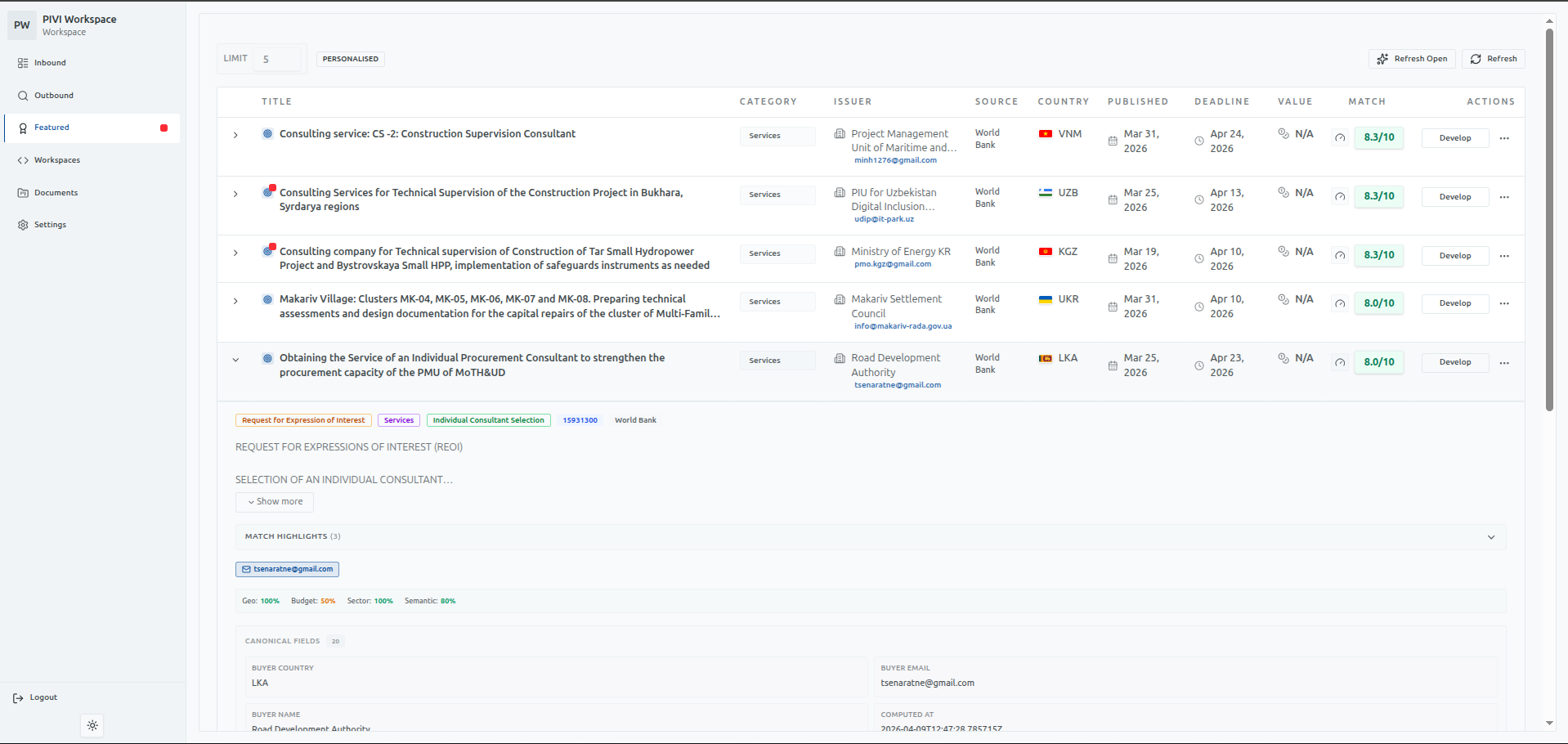
Two views of the same market: Notices is the complete, browsable index with natural-language search and structured filters; Featured is your firm's ranked, scored shortlist, grouped by the day each opportunity arrived.

Featured matches feed in Klarum
  • Browse the entire open market with no hidden filters
  • Get a daily ranked shortlist tuned to your capabilities
  • Promote any single notice for full scoring on demand
  • Save and reuse named filter views that slice instantly

Why it's better

Results stream in progressively so the feed never blocks on a spinner, and switching saved filter views re-slices a cached shortlist at read time: instant, with no recompute.

The everyday discovery surface that feeds the matching engine and the daily digest email.

Win

Run the whole bid in one place.

From selecting an opportunity to a submitted Expression of Interest: requirements, data room, drafting, meetings and outreach fused into a single cockpit.

Bid Workspaces

The proposal cockpit

One persistent place to develop a single opportunity from selection to submission, with lifecycle state, a deadline, an assigned bid manager and team, and seven purpose-built tabs: Overview, Items, Data room, Documents, Generated EOI, Recordings and Conversation.

  • Replace the juggling of email, Word, shared folders and spreadsheets
  • See exactly what the tender requires as an actionable checklist
  • Assemble and semantically search a per-bid data room
  • Capture meetings as transcripts, summaries and action items

Why it's better

The platform does not just store files, it understands them. Tender text becomes structured requirements, uploads become searchable evidence, and every AI feature reads from one shared knowledge base instead of re-uploading context each time.

AI inside

Requirement extraction turns a tender PDF into a tracked checklist; meeting audio becomes a diarised transcript with summary and action items; retrieval-grounded search lets you quote your own documents with citations.

The operational heart, downstream of Discovery and upstream of Records and Analytics.

Generated EOI

A submission-ready document, drafted from your evidence

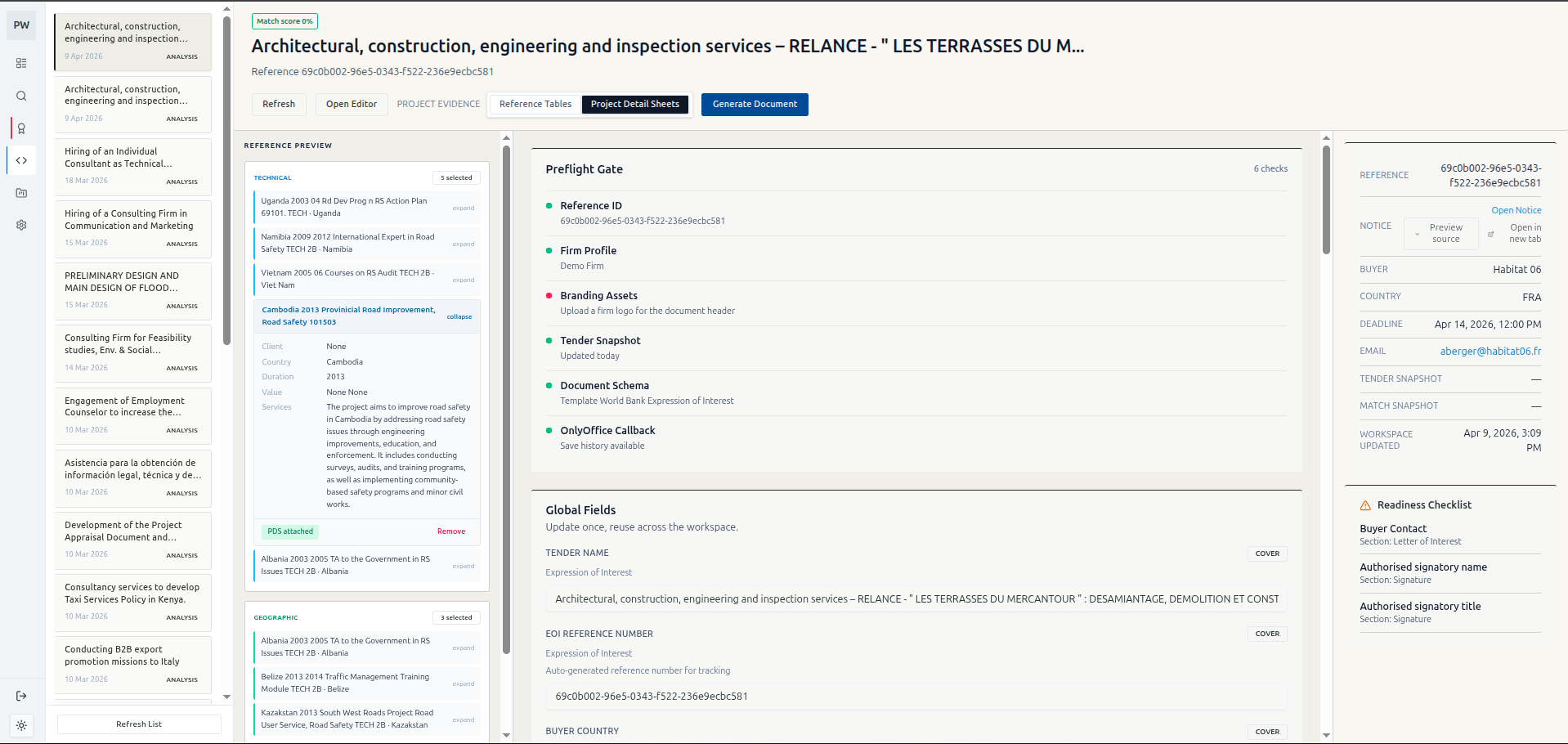
One-click generation of an Expression of Interest, drafted from your firm's real reference projects and the tender context, rendered into a branded DOCX and PDF and editable inline in a full rich-document editor.

  • Produce a first draft in minutes, not days
  • Ground every section in real, firm-owned references
  • Edit inline with AI-assisted selection rewrite
  • Promote a strong result into a reusable firm template

Why it's better

Each section is drafted with retrieval-grounded generation against your firm's track record, then stitched into the official template and converted to a branded document, with citations validated against your real reference list so generated bids only cite projects you actually delivered.

AI inside

Reference selection ranks your past projects by geographic, sector, recency and scale fit; per-section drafting is grounded in retrieved passages; an anti-hallucination guard strips any citation that does not map to a real reference.

The headline deliverable of a Workspace; promoted templates feed firm settings and future bids.

Templates

Your house structure, reused on every bid

Two reusable systems: document templates (the section tree and typed slots of an EOI, technical proposal or report) and checklist templates (the firm-wide task list that seeds every new workspace).

  • Define your proposal structure once and reuse it everywhere
  • Fork platform standards into a fully editable firm copy
  • Auto-suggest the right checklist when a buyer matches
  • Snapshot a good workspace into a new reusable template

Why it's better

Templates are deterministic scaffolding: the section tree controls structure and tone per section, while typed slots tell the generator exactly which firm and tender data to ground each piece in. Flexibility with structure, not a fragile copy-paste.

Consumed by Workspaces (drives EOI generation and seeds checklists) and managed in firm settings.

Records

Your bid ledger, finally live

A spreadsheet-native ledger of every bid, EOI and project the firm has pursued: typed columns plus firm-defined custom fields, editable inline like Excel but multi-user, searchable and structured.

  • Replace the master bid-tracking spreadsheet with a live table
  • Import an existing workbook and land your history in one step
  • Promote any tracked bid into a full working workspace
  • Generate branded PDF reports by quarter, sector or country

Why it's better

A two-way sync engine keeps a record and its linked workspace aligned cell-by-cell, translating between representations deterministically and escalating genuine ambiguity to you rather than guessing.

AI inside

When you import a spreadsheet, a language model maps your idiosyncratic column headers to the firm's typed schema with a confidence flag, so a legacy workbook imports cleanly instead of needing every column hand-mapped.

The system of record for the firm's own bid history, linked to Workspaces and Documents.

Intake

Turn a link into a structured deal-flow channel.

Your branded public front door for inbound opportunities: applicants submit conversationally or by form, and every submission lands as scored, workspace-ready deal-flow.

Public Portal & Inbound

A branded front door for applications

An unauthenticated, firm-branded portal where sub-consultants, partners and applicants submit a project, either by chatting with an intake assistant or filling a form you design, attach the source documents, and get a reference number and a self-serve status page.

  • Replace scattered RFP emails with one structured channel
  • Let applicants submit in under a minute, no account needed
  • Configure exactly what you collect with a no-code builder
  • Receive every submission as scored, triage-ready deal-flow

Why it's better

One builder schema drives both the public form and server-side validation, so there is no drift; matcher-critical and identity fields are locked so a firm can customise freely without ever breaking matching or losing an applicant's email.

AI inside

A conversational intake assistant runs a structured slot-filling chat that normalises a free-form description into your required fields; attached RFPs are auto-extracted for issuer, budget, deadline, sector and document type.

The inbound on-ramp; submissions converge with discovered tenders on the same pipeline as Inbound projects.

Inbound Projects

A scored, evidence-backed triage queue

The firm-facing inbox for applications you receive. Each lands as a Project with an AI-computed fit score and a per-criterion breakdown, and one click accepts it into a workspace or records a structured decline.

  • Triage inbound deal-flow without opening every PDF
  • Decide with a per-criterion breakdown and evidence, not gut feel
  • Accept into a workspace, or decline with a recorded reason
  • Export queues to Excel or ZIP for committee packs

Why it's better

Inbound and outbound converge on the same workspace machinery: accepting a project runs the identical promotion stack as developing a discovered tender, so a firm's whole pipeline is unified regardless of how an opportunity entered.

AI inside

The same matching ensemble that ranks discovered tenders scores inbound applications, surfacing evidence snippets that pair a firm capability against an applicant requirement so the score is auditable.

The demand-side half of the deal-flow funnel, feeding Workspaces and Records.

Know

Make your track record machine-usable.

Turn a pile of profiles, references and CVs into a structured, evidence-backed capability graph: the firm context every AI feature reasons over.

Firm Knowledge

A capability graph, derived from your documents

The system of record for what your firm knows and has done: profile, references, project detail sheets, CVs and past proposals, turned from documents into a structured, queryable capability graph plus a searchable knowledge corpus.

  • Auto-derive a capability inventory you never had to curate
  • Power matching with your firm's specific, evidenced signal
  • Surface deployable personnel from uploaded CVs
  • Package institutional knowledge into shareable playbooks

Why it's better

Capabilities are typed nodes backed by the exact passage, page and confidence that evidence them, so a stated capability is backed by citable proof, not asserted. That is what makes matching and drafting defensible rather than hallucination-prone.

AI inside

Documents are parsed, chunked and embedded, then a language model tags each passage against a controlled capability vocabulary with explicit-versus-implied confidence, building an auditable graph the matching engine and document generator read from.

The firm-context substrate the whole AI stack reads from: matching, EOI generation and the agent.

Documents

Files become queryable, citable evidence

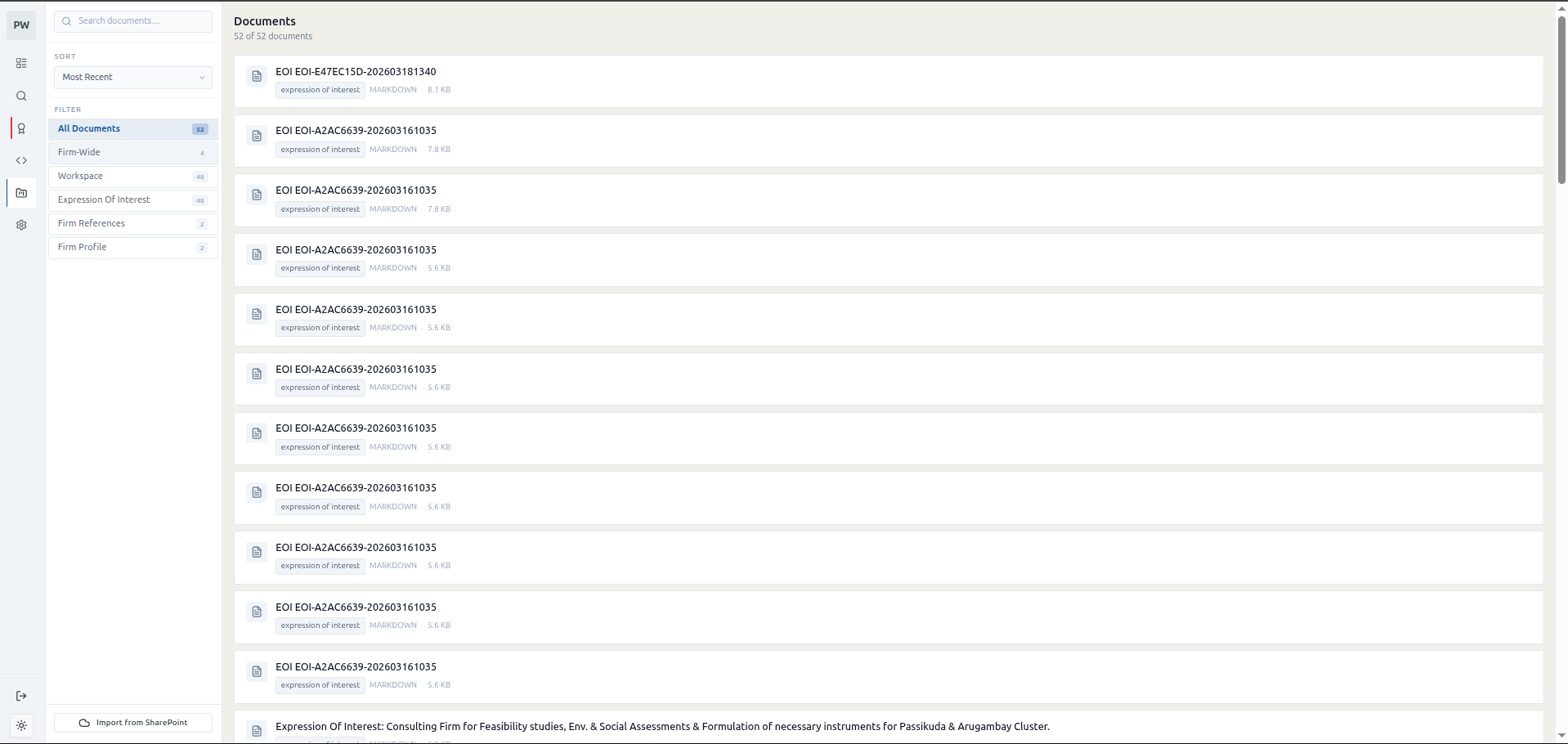
The central library and reader for everything the platform touches: firm credentials, cloud-drive imports, workspace attachments and generated proposals, with usage tracking and a per-tender relevance heatmap.

Document library and reader in Klarum
  • Keep one source of truth for firm credentials and references
  • Import directly from Google Drive, OneDrive and SharePoint
  • See exactly how and where each document has been cited
  • Understand why a document supports a specific tender

Why it's better

Every upload is parsed, chunked and embedded so it becomes queryable evidence, not dead storage. Open a reference from a tender and a heatmap highlights the exact passages the match engine leaned on: defensibility at the sentence level.

AI inside

Layout-aware parsing preserves tables and structure; embeddings make every file semantically searchable; a passage-level heatmap makes the match engine's reasoning legible.

The evidence layer feeding Workspaces, EOI generation and tender-match explanations.

Issuers

A buyer book that outlives any one bid

A lightweight CRM-style register of the contracting authorities and buyers a firm cares about: each a profile with a shared timeline of meetings, calls and decisions, a contact list, and every workspace ever run against that buyer.

  • Build a durable buyer book that survives staff turnover
  • Keep institutional memory in one place, not someone's inbox
  • See the whole relationship and engagement history at a glance
  • Promote durable lessons into the firm knowledge base

Why it's better

An issuer is the canonical buyer identity the rest of the platform points at, so the engagement scoreboard on the buyer record and the past-engagements strip in a workspace are two views of one query, with no drift.

AI inside

When enabled, the AI copilot can capture call and meeting notes straight onto a buyer's timeline, bound to the workspace's buyer so it can never write to the wrong record.

The canonical buyer primitive that Workspaces, the agent and the knowledge base all pivot on.

Operate

Run the bid team at volume.

The command centre, the cross-bid task tracker, the performance and market dashboards, and the automation engine that fires bid work as one click.

Dashboard & Items

What's on fire, and one place to track it all

A firm-wide command centre that triages what needs attention today, plus a cross-workspace Items cockpit: a task tracker that spans every bid the firm runs, with everything that creates work funnelled through a review queue first.

  • See in one glance which bids need you today
  • Track all work across every bid in one backlog
  • Never lose a tender obligation to a buried requirement
  • Review AI-suggested work before it becomes a task

Why it's better

Dashboard widgets hide themselves when there is no signal, so the view stays calm when the firm is calm. Nothing writes a task directly: extracted requirements, templates and suggestions all stage as proposals you accept or dismiss, with a single dedupe gate.

AI inside

Deadline-accurate triage, a latent-capabilities card that surfaces strengths your CVs evidence but you have not declared, and a top-ranked featured-matches strip, all read from the shared matching and knowledge substrate.

The hub of the authenticated app; the connective tissue across every Workspace.

Analytics & Market Intelligence

How your team performs, and where the market moves

Two dashboards: Firm Analytics answers how your bid team is performing (throughput, SLA, pipeline funnel, win rate); Market Analytics answers what the market is doing over the entire indexed tender corpus, with a forecast and a natural-language market analyst.

  • Track throughput, deadline risk and win rate on real data
  • Read the pipeline as a CRM-style conversion funnel
  • Size and segment the addressable market every way that matters
  • Ask the market plain-English questions and get grounded answers

Why it's better

KPIs are computed off the firm's real workspace and activity data, not self-reported numbers, and tie to the same tender deadlines used everywhere else, so SLA reporting matches what users see in their workspaces.

AI inside

A statistical volume forecast with an honest uncertainty band, window-over-window trend detection, and a retrieval-grounded market analyst that answers questions against live aggregates so its numbers stay faithful to the corpus.

The measurement layer over the operational and market data substrates.

Automations

Fire bid-production work as one click

The console over the platform's process engine: declarative, auditable multi-step workflows that run against bid data. A catalogue of platform-shipped and firm-authored automations, plus a live ledger of every run with its inputs, outputs, cost and per-step trail.

  • Run EOI generation, matching, compliance checks and more in one click
  • Get the right automation suggested in a workspace's context
  • Author your own automations by describing them in plain English
  • Audit every run end to end and export the output as a branded document

Why it's better

Unlike a generic no-code tool, the engine is narrow and auditable by design: workflows are validated specs that operate on the same canonical bid data as the rest of the platform, with full tenant isolation and per-step budget caps baked in.

AI inside

Workflow steps run real prompts to turn data signals into client-ready prose and to classify uploads; plain-English descriptions are safely drafted into runnable, restricted workflows.

The orchestration substrate every agentic and processing flow runs through.

AI Copilot

One assistant that knows your firm, and can act.

A conversational AI copilot that sits across the whole platform. It reasons over your firm's own data: projects, tenders, workspaces, documents, recordings and analytics, calls tools to read and act on that data, searches the web, and can even operate the screen you are looking at.

  • Find and triage your pipeline in plain language
  • Interrogate firm knowledge with cited, page-level answers
  • Take action: update status, export, draft outreach, build checklists
  • Operate the current screen by text, like reorder by deadline or assign Maria

Why it's better

It is grounded, not generic: every answer is scoped to your firm and, inside a workspace, hard-pinned to that bid so context never leaks across deals. Knowledge answers come back as citations with document, page and relevance: quotable, not hallucinated. Read access is open; write actions are gated behind an explicit firm opt-in.

AI inside

A tool-using reasoning agent over a retrieval-grounded knowledge base, with multi-turn memory and a catalogue of 20-plus tools spanning search, read, action and live UI control. The model is provider-flexible, so model choice is a setting, not a rewrite.

The cross-cutting AI control surface: standalone hub and embedded everywhere you work.

See the whole platform on your own bids.

Start free, connect your references, and watch the right tenders surface: ranked, explained, and ready to develop into a submitted bid.